
The Growing Importance of Spanish in the US Job Market: Bilingual Career Opportunities

Over 256,000 Spanish-related job listings on Indeed and 105,000+ on Glassdoor tell a clear story: bilingual career opportunities US professionals can access have never been more abundant. The numbers keep climbing alongside the Hispanic population, now the largest minority group in the country.
Mastering Spanish goes far beyond cultural enrichment. It’s a strategic career move that unlocks higher salaries, broader job prospects, and faster paths to leadership. Whether you work in healthcare, finance, education, or tech support, employers actively seek professionals who bridge the English-Spanish divide.
This article covers the top industries hiring bilingual workers, the salary premiums you can expect, eight high-paying career paths, and practical steps to build professional-level Spanish skills that actually get you hired.
Why Spanish is the most in-demand language in the US job market
Spanish dominates bilingual job postings across the country, appearing in 86% of all listings that require a second language. No other language comes close. With over 41 million native speakers living in the US (plus millions more who speak it as a second language), employers face a simple reality: they need staff who can communicate with this massive consumer and workforce base.
Working with a qualified spanish tutor represents one of the fastest ways to develop the professional fluency employers demand. The investment pays off quickly when you consider what’s at stake for businesses that lack bilingual talent.
The U.S. Committee on Economic Development (CED) reports that companies lose over $2 billion annually due to language and cultural misunderstandings. That’s not a theoretical figure. It shows up in botched negotiations, lost clients, compliance failures, and preventable medical errors.
A 2019 ACTFL survey found that 90% of US employers rely on employees who communicate in languages other than English. Even more telling, 56% anticipated their need for bilingual speakers would increase. Fast forward to 2026, and that prediction has materialized across nearly every sector.
Healthcare systems struggle to serve patients with limited English proficiency. Schools need bilingual educators for increasingly diverse classrooms. Government agencies require Spanish-fluent caseworkers. Customer service centers can’t function without bilingual representatives.
The 2026 job market adds urgency. Graduate underemployment sits at historically high levels, and competition for desirable positions keeps intensifying. Bilingual skills serve as a powerful differentiator, the kind of concrete advantage that moves your resume to the top of the pile when hundreds of candidates hold similar degrees.
How much more do bilingual professionals earn? The salary premium explained
The bilingual salary advantage operates across industries, role levels, and geographic regions. It rewards professionals who can do what monolingual colleagues simply cannot: reach wider audiences, serve diverse clients, and navigate cross-cultural business relationships.
The bilingual pay differential: 5% to 20% more than monolingual peers
Research consistently shows bilingual employees earn between 5% and 20% more than their monolingual counterparts. The average premium for bilingual professionals in the US reaches approximately $14,050 per year, translating to an 18.8% pay increase.
Bilingual MBA holders see an even sharper advantage, earning 22% more in starting salaries compared to monolingual MBA graduates. That gap compounds over a career spanning decades.
Glassdoor’s 2026 data puts the average salary for bilingual roles at roughly $68,851 per year, with top earners reaching $125,998. These figures span industries, so your specific field and experience level determine where you land on that spectrum.
How employers structure bilingual compensation
Companies use several models to reward language skills. Some offer hourly premiums ranging from $0.50 to $3+ per hour. Others provide annual stipends between $1,000 and $7,000. Percentage-based differentials and quarterly bonuses round out the common approaches.
Most employers don’t just take your word for it, though. Language proficiency assessments typically precede any pay differential approval. You’ll need to demonstrate real fluency, not just conversational basics.
California stands out with specific laws mandating bilingual pay differentials for designated state jobs. That legal framework partly explains why nearly half of the top 20 highest-paying cities for multilingual workers sit in California. The state puts its money where its policy is.
Top 8 high-paying career paths for Spanish-English bilingual professionals

Bilingual Spanish-English speakers access some of the most lucrative and fastest-growing career paths in the US economy. Here are eight roles where language skills directly translate to higher earning potential.
Business and finance roles: marketing directors, investment bankers, and risk managers
Marketing directors ($120,000+) who speak Spanish can tap into the US Hispanic consumer market worth trillions of dollars. Crafting campaigns that resonate culturally, not just linguistically, gives bilingual marketers a massive edge. Brands that authentically connect with Hispanic audiences consistently outperform those relying on translated content.
Investment bankers ($88,000+) with Spanish fluency reach international and Latin American clients that monolingual bankers simply can’t access. Cross-border deals, emerging market analysis, and relationship management all benefit from direct communication without interpreters slowing things down.
Risk managers ($99,000+) need to assess workplace hazards accurately. When your workforce includes Spanish-dominant speakers, understanding their reports, concerns, and observations firsthand prevents costly oversights. Miscommunication in risk assessment doesn’t just cost money. It costs lives.
Healthcare, social work, and public service roles
Role | Salary Range | Why Spanish Matters |
Bilingual nurses | $67,000+ | Reduce medical errors with LEP patients |
Social workers | $42,000+ | Build trust through a client’s heart language |
Immigration specialists | $60,000+ | Guide foreign citizens through US legal processes |
Public health outreach | $45,000+ | Reach underserved Hispanic communities |
Bilingual nurses deliver safer care. When a patient can describe symptoms, pain levels, and medical history in their native language, diagnostic accuracy improves dramatically. Hospitals in regions with large Hispanic populations actively recruit Spanish-speaking nurses and often pay premium rates.
Social workers who communicate in a client’s first language build trust faster and achieve better outcomes. For vulnerable populations navigating complex systems, that linguistic bridge can mean the difference between accessing services and falling through the cracks.
Translation, education, and customer service careers
Translators and interpreters enjoy projected job growth of 17-20% over the next decade, far outpacing most occupations. The Bureau of Labor Statistics flags this field as one of the fastest-growing career categories in the country.
Bilingual educators face surging demand as schools serve increasingly diverse student populations and introduce foreign language instruction at younger ages. Districts across Texas, Florida, New York, and California struggle to fill these positions.
Customer service remains the single largest category for bilingual hiring, with over 7,000 active listings seeking Spanish-speaking candidates. Call centers, tech support teams, and client success departments all need staff who can resolve issues without language barriers.
Hospitality managers round out the list. Hotels, resorts, and tourism operations serve visitors from across Latin America and need bilingual staff at every level, from front desk to executive management.
Which industries are hiring the most bilingual workers in 2026?
Sales leads the pack with over 5,800 bilingual job listings. Account managers and real estate agents top the specific roles, because closing deals requires trust, and trust builds faster when you speak someone’s language.
Customer service follows closely with 7,000+ listings for bilingual candidates working in call centers, tech support, and client-facing roles. This sector has grown steadily as companies recognize that frustrated customers who can’t communicate don’t stay customers for long.
Healthcare rounds out the top three. Hospitals, clinics, and community health organizations need bilingual workers for patient communication, medical interpretation, and outreach programs targeting underserved communities.
- Sales (5,800+ listings): account managers, real estate agents, business development
- Customer service (7,000+ listings): call centers, tech support, client success
- Healthcare: patient communication, interpretation, community outreach
- Education: bilingual teachers, ESL instructors, curriculum developers
- Government and legal: courts, immigration, public agencies
- International business: negotiations, Latin American market strategy
- Hospitality and air transport: growing demand for front-line bilingual staff
The government and legal services sector maintains steady demand for interpreters and bilingual caseworkers in courts, immigration facilities, and public agencies. International business operations need bilingual employees who can handle negotiations and client relations with Spanish-speaking countries.
Beyond the paycheck: cognitive and professional advantages of bilingualism
Bilingual professionals bring sharper problem-solving abilities, stronger multitasking capacity, and more nuanced decision-making to every role they fill. These cognitive advantages show up in performance reviews, not just research papers.
The career impact goes beyond skills. Bilingual individuals enjoy up to 35% greater job prospects because they bridge cultural divides that monolingual candidates can’t cross. That cultural competency enhances collaboration in diverse teams and opens doors to leadership positions faster.
Multilingual employees receive raises 5% more often than monolingual colleagues. And 40% of multilingual professionals report that their language skills directly helped them land their current job. Those aren’t marginal differences.
Evidence also links multilingualism to reduced cognitive decline and long-term brain health benefits. You’re not just investing in your career. You’re investing in your future self.
Bilingualism accelerates promotions because managers notice employees who can handle client relationships, team communications, and stakeholder meetings across language barriers. You become the person everyone needs in the room.
How to build professional-level Spanish skills for career growth
Recognizing the opportunity means nothing without action. The gap between “I should learn Spanish” and “I speak professional Spanish” requires a clear strategy and consistent effort.
Setting clear language goals aligned with your career path
Start by identifying your target industry and the specific vocabulary it demands. Medical Spanish differs dramatically from legal Spanish, which looks nothing like business Spanish. Generic fluency won’t impress employers who need specialized communication skills.
Employers increasingly seek interdisciplinary abilities. They want candidates who combine language proficiency with data analysis, cross-cultural negotiation, or technical communication skills. Position yourself at that intersection.
Professional certifications boost employability significantly. The American Translators Association (ATA) certification signals credibility to employers. Language proficiency assessments from services like ALTA Language Services often serve as prerequisites before companies grant bilingual roles or pay differentials.
Map your learning path to concrete milestones: passing a proficiency exam, conducting a mock business negotiation in Spanish, or writing professional emails without assistance.
Why one-on-one tutoring is the fastest path to professional fluency
Personalized lessons tailored to your career goals and industry jargon accelerate learning in ways group classes and apps cannot match. A tutor who understands your professional context focuses every session on vocabulary and scenarios you’ll actually encounter at work.
Platforms like Superprof connect learners with qualified tutors across the US. With access to over 20 million tutors spanning 40 countries and 1,200+ subjects, finding someone who matches your professional needs takes minutes, not weeks.One-on-one tutoring delivers real-time feedback, flexible scheduling around demanding work hours, and a customized curriculum that evolves as your skills grow. You practice speaking from day one instead of passively absorbing grammar rules.
The return on investment speaks for itself. A few months of focused tutoring can add six figures to lifetime earnings when you factor in salary premiums, promotion opportunities, and expanded job access. Few investments in professional development offer that kind of payoff.
Regional hotspots: where bilingual Spanish speakers earn the most in the US
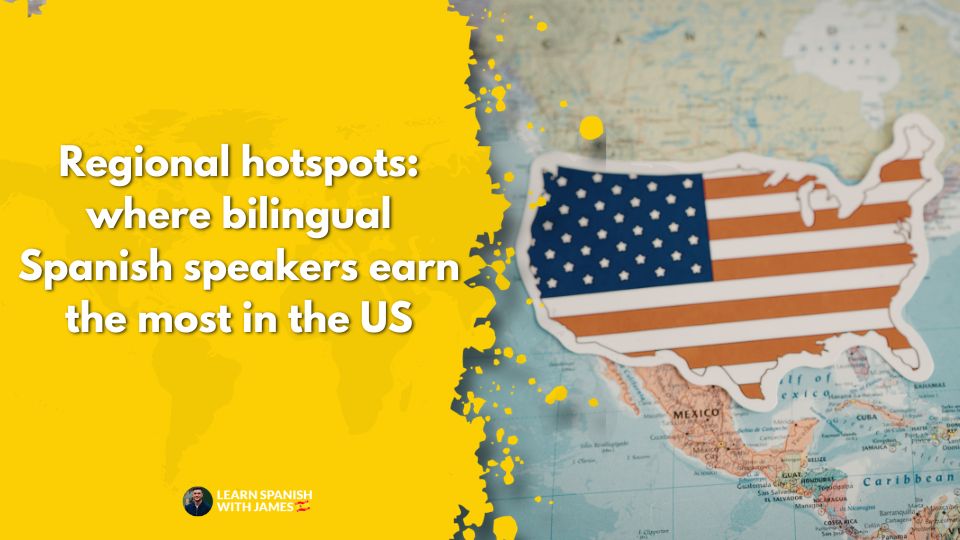
Fremont, California pays the highest salaries for full-time multilingual employees, averaging $67,804 per year. San Francisco follows at $66,468. The national average sits at $51,833, so California’s premium cities offer roughly 30% more.
Nearly half of the top 20 highest-paying cities for multilingual workers cluster in California, driven partly by state laws mandating bilingual pay differentials for designated positions. The legal framework creates a floor that other states haven’t matched.
Region | Average Bilingual Salary | Key Industries |
Fremont, CA | $67,804 | Tech, healthcare |
San Francisco, CA | $66,468 | Finance, tech, services |
Texas (major cities) | $52,000–$60,000 | Sales, healthcare, education |
Miami, FL | $50,000–$58,000 | International business, hospitality |
New York, NY | $55,000–$65,000 | Finance, legal, media |
Texas, Florida, New York, Arizona, and Nevada particularly value bilingual employees in customer service and social services roles. These states have large Spanish-speaking populations that drive consistent demand.
Remote work has reshaped the landscape. Bilingual workers now access high-paying California or New York roles from anywhere in the country. Geography matters less when your language skills travel with you.
Miami deserves a special mention as the hub for Latin American business. Bilingual skills are essential there, but the deep candidate pool moderates salary premiums compared to cities where Spanish speakers are scarcer.
FAQ
How much more do bilingual employees earn compared to monolingual workers in the US?
Bilingual professionals earn between 5% and 20% more than monolingual peers, with an average premium of approximately $14,050 per year (an 18.8% increase). Bilingual MBA graduates can earn up to 22% more in starting salaries, and top bilingual roles reach $125,998 annually.
What is the most in-demand second language for US jobs in 2026?
Spanish dominates, appearing in 86% of all bilingual job postings across the US. With over 41 million native speakers in the country, demand spans healthcare, education, sales, customer service, and government. No other language comes close to matching this level of employer interest.
What are the best careers for Spanish-English bilingual speakers?
Top careers include marketing director ($120,000+), investment banker ($88,000+), risk manager ($99,000+), healthcare professional ($67,000+), translator/interpreter, bilingual educator, customer service representative, and immigration specialist ($60,000+). Salary ranges vary by experience, location, and industry.

About James – Or Should that be Santiago?
My name is James. I am a Brit with a love for the Spanish language. I have lived in Spain, Argentina, and Costa Rica, and I have been teaching Spanish for over a decade. This site will show you how to master the elements of Spanish grammar that often dishearten learners. I hope you enjoy the site and find it useful.
If you are interested in taking your Spanish to the next level, check out the Courses section for a full list of the Spanish courses I suggest. All reviews are based on my personal opinions.