Pura Buena Onda Review – The Best Spanish School in San Diego

If you’ve ever sat through years of Spanish classes, passed the exam, and still couldn’t hold a basic conversation, you’re not alone. And you’re definitely not the problem. The method is.
Recently, I had the chance to sit down and chat with Carolina Mery, the founder of Pura Buena Onda, a conversational Spanish school based in San Diego.
And honestly, it was one of the most refreshing conversations I’ve had about language learning in a long time.
What started as a one-woman operation teaching private classes in people’s homes has grown into a school running over 80 classes per week with more than 500 active students.
Here’s what Caro had to say.
First things first – what is Pura Buena Onda?
For anyone who hasn’t come across it before, the Pura Buena Onda Spanish school (PBO for short) is a conversational Spanish school founded in San Diego back in 2007.
It operates primarily online via Zoom, which means you can learn Spanish in San Diego or from anywhere else in the world without fighting traffic or rearranging your entire schedule.
Around 60 to 70% of their students are based in San Diego, but the rest are spread across the US and internationally, making PBO a genuinely global community built on a very San Diego spirit.
You went from teaching private classes in people’s homes to running 80 classes a week. What was the scariest part of that growth?
“I think the scariest leap was hiring other people,” Caro told me. “For a while, it was just me. At the beginning, 18 years ago, it was just me, and then all of a sudden the amount of requests for classes – I knew I couldn’t fill it myself.
I knew I had to hire other people, and I did not want to hire other people. I had worked in hospitality before, I’d been in management, I knew what it was like to manage people, and I didn’t wanna do it. But the demand was there.”
It’s a very relatable fear for anyone who has built something from scratch. You have your vision, your method, your standards, and bringing other people in to deliver that feels like a genuine risk.
But as Caro puts it, the demand just kept growing and growing, so the leap had to be made.
How do you explain the conversational immersion method to someone who only knows textbook learning?
This is where Caro really lit up, and I think her answer is one of the best explanations of communicative language learning I’ve ever heard.
“I think the best way to explain what we do is to compare it to learning a sport. You would never in a million years, if you wanted to learn soccer or baseball, take an academic approach, and language learning is no different.
You have to get on the field and have a ball thrown at you to start playing. You can sit in a classroom all you want, read all the rules, memorise them, and be quizzed on them a thousand times. But if you can’t play, what’s the point? The way to learn baseball is to get on the field. That’s the same exact idea as learning a language.”
It sounds obvious when she says it like that. But how many of us spent years in language classes doing exactly the opposite?
What’s the most common bad habit students have when they start learning Spanish?
“Being in your head,” Caro said, without hesitating. “Not letting go of translating every single word. Not following your instincts. Trying to conjugate in your head before you speak. To me, those are the worst habits, because those don’t allow you to properly communicate.”
She was quick to point out that perfection is not the goal at PBO.
“If I were learning a language right now and I had to stop every few seconds to get it exactly right, this conversation would be endless and horrible for the other person.
But if I accidentally use the wrong word or say it incorrectly, they’re still going to understand me. Communication is our goal. That is what we strive for.”
It’s a mindset shift that I think a lot of learners genuinely need to hear.
Where did the idea for this method actually come from?
The origin story is a great one. Caro was teaching a local San Diego DJ, a heritage speaker whose parents were Mexican, using a traditional textbook approach.
And every single time she arrived at her house, the student would close the book and say: “Let’s just talk.”
“And I realised through that, she is learning so much more by just having conversations than by the book,” Caro told me.
“With the book, she was learning some vocabulary she wasn’t even going to use. So I developed the method. She is really the reason why I decided to open up the school. Because I realised – wow, this really works.”
She tried it on a few more students just to make sure it wasn’t a one-off. It wasn’t. And the rest, as they say, is history.
What do the Spanish classes actually look like in practice?
No textbooks. No filling in the blanks. No memorising conjugation tables in isolation. Instead, students discuss real topics; their holidays, their families, their opinions, their lives.
And the language is absorbed naturally through conversation.
In lower-level classes, Caro describes using a round-robin format: the teacher asks one student a question in Spanish, helps them answer, and then that student asks the same question to the next person.
Each person answers differently, so the whole class is hearing new vocabulary in real context.
“You learn things – cat, dog, parakeet, whatever – but you learn them in context. If you remember that your classmate John has a parakeet, you’ll remember that word for the rest of your life. If you’re just reading about Johnny at the library in a textbook, you don’t care about Johnny.”
Honestly? She’s not wrong.
How does PBO track student progress if grammar isn’t the focus?
PBO has eight levels – A1, A2, A3, B1, B2, B3, C1, and C2, which is slightly more granular than the standard European CEFR framework.
But the way they assess progress is quite different from most schools.
“We’re looking more at the art of the language,” Caro explained. “How fast are you able to get words out of your mouth? Do you understand when someone is asking you a question? How rich is your vocabulary?
How easily are you able to express yourself when you’re angry, embarrassed, when you have an opinion? That’s what we base the levels on – more than whether a student can use the preterite versus the imperfect.”
The science of language versus the art of language. I love that distinction, and I think it captures something really important about what genuine fluency actually feels like.
What about life outside the classroom?
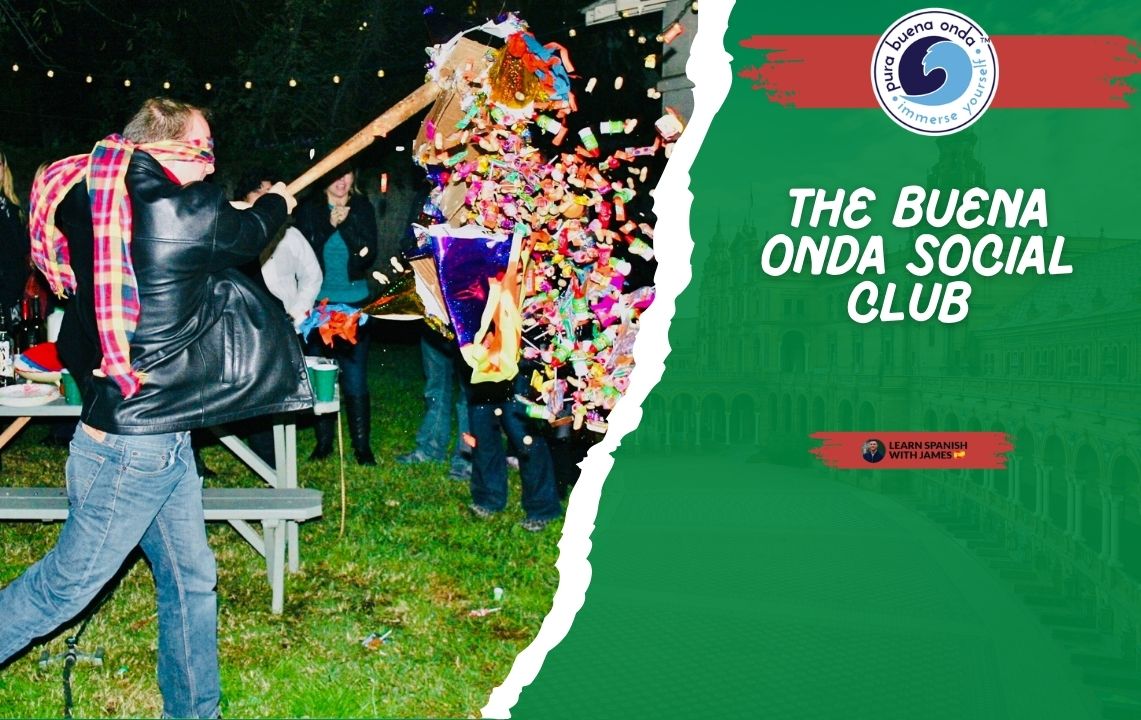
This is one of my favourite things about PBO, and something that genuinely sets them apart as the best Spanish school in San Diego for building real-world fluency.
The Buena Onda Social Club runs 11 events per year, February through December, and eight of those are in-person in San Diego.
Activities have included axe-throwing (pero en español), picnics, barbecues, potlucks, visits to the San Diego Latino Film Festival in March, and a posada at a student’s home at Christmas.
They’ve also carried out day trips across the border to Tijuana, Tecate, and the Valle de Guadalupe, a wine valley about two hours south of Tijuana that Caro reckons gives Napa and Sonoma a serious run for their money.
For students who aren’t in San Diego, three events per year are held virtually, and PBO also runs a Spanish buddy system, pairing students up to practise via Zoom, WhatsApp, or phone calls between classes.
Any final thoughts from Caro on how Spanish should be taught?
I asked her: if she could change one thing about how Spanish is taught in the US school system, what would it be?
“I would have people sit in a circle and have a conversation. It’s so easy, and people don’t do it. I don’t understand the whole textbook idea. It doesn’t work. So few people graduate from high school speaking the language they studied – year after year after year – and yet it continues.”
Hard to argue with that.
My Verdict – This is the Best Spanish School in San Diego
This Pura Buena Onda review should give you a clear picture of what makes this school genuinely different.
It’s not a place where you’ll sit quietly, fill in worksheets, and hope that fluency arrives one day. It’s a place where you get on the field from day one, make mistakes, laugh, connect with people, and actually start speaking Spanish.
Eighteen years, 500+ students, and 80 classes per week later, the results speak for themselves.
If you want to learn Spanish in San Diego, or anywhere in the world, in a way that is genuinely effective and genuinely enjoyable, the Pura Buena Onda Spanish school is absolutely worth your time.
About James – Or Should that be Santiago?
My name is James. I am a Brit with a love for the Spanish language. I have lived in Spain, Argentina, and Costa Rica, and I have been teaching Spanish for over a decade. This site will show you how to master the elements of Spanish grammar that often dishearten learners. I hope you enjoy the site and find it useful.
If you are interested in taking your Spanish to the next level, check out the Courses section for a full list of the Spanish courses I suggest. All reviews are based on my personal opinions.